Why I made this website
I created this website because I do not want people to become sick or experience unexpected blood sugar problems after baking with sweeteners they believed contained absolutely no sugar or carbohydrates. When a recipe calls for large amounts of powdered or granulated sweetener, small amounts of dextrose or maltodextrin per serving can add up. My goal is to help people read the ingredients, understand what they are using, and make informed choices—especially if they are sensitive to sugar or carefully managing their carbohydrate intake.
Baking reminder: Check the total amount of sweetener in the entire recipe, not just the tiny serving size on the package. The amount of carbohydrate in each finished portion depends on the quantity used and the number of portions.
What's hiding in plain sight?
The sweetener itself—sucralose or stevia extract—is only part of the story. Powdered products often use bulking ingredients so a tiny amount of intense sweetener can be measured and poured easily.
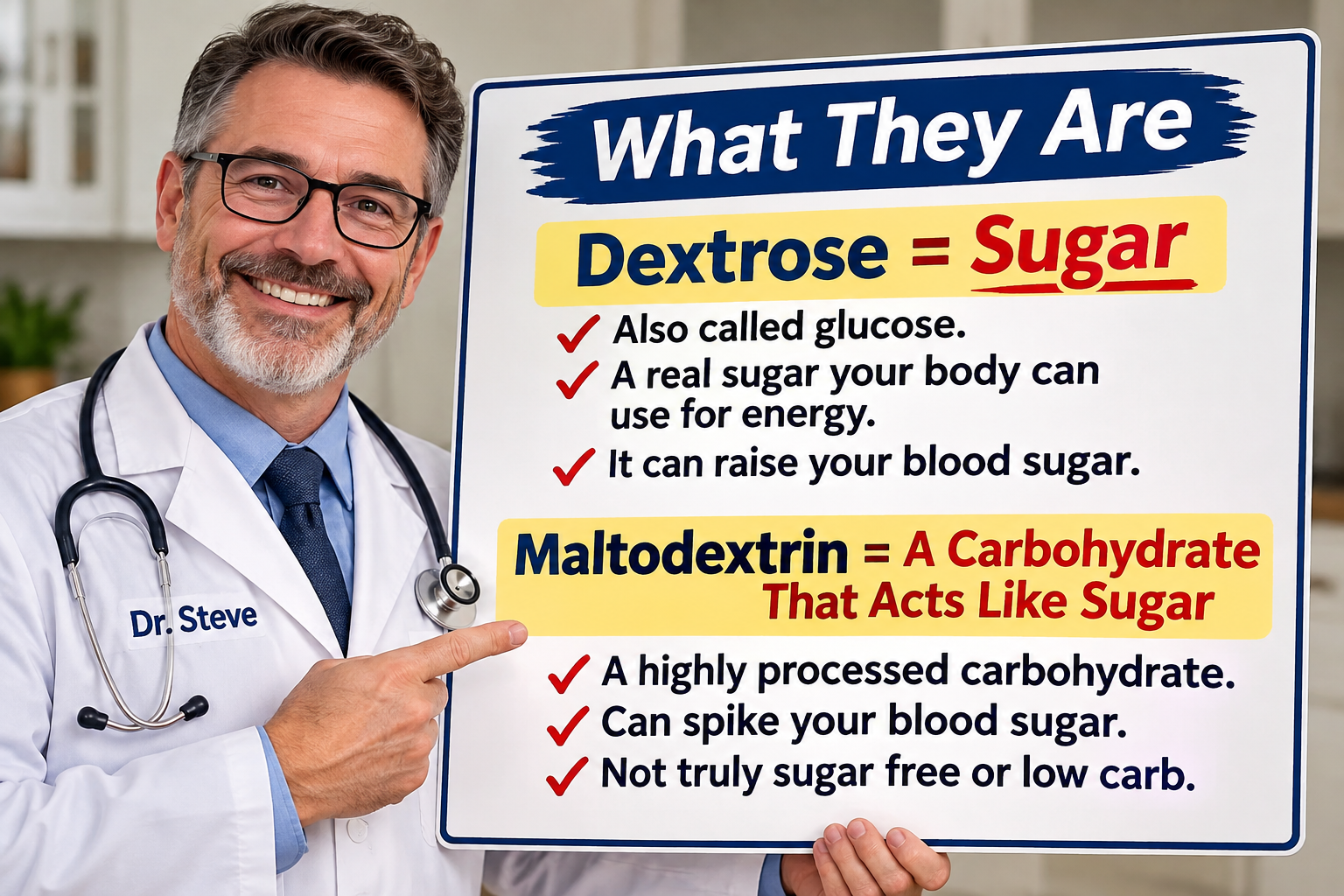
A form of sugarDextrose = glucose
Dextrose is chemically glucose, a simple sugar that the body can absorb and use for energy. It can raise blood glucose. A packet containing dextrose is therefore not literally free of sugar molecules, even when the nutrition label legally rounds its sugar content to zero.
A digestible starch-derived carbohydrateMaltodextrin can raise blood sugar
Maltodextrin is not usually counted as “sugars” on a Nutrition Facts label, but it is a rapidly digestible carbohydrate. It can raise blood glucose, especially in meaningful amounts. The actual effect of a tiny serving depends on dose and individual response.
Four products, four ingredient listsWhat Splenda lists in these products
Ingredient lists below are taken from the manufacturer's linked product pages. They show why checking the specific format—packet versus granulated—is important.
Original · PacketsSplenda Sweetener Packets
Dextrose · Maltodextrin · Sucralose
Contains both a simple sugar and a digestible carbohydrate. Consider the cumulative amount if using many packets.
See manufacturer's ingredient list ↗Original · GranulatedSplenda Granulated Sweetener
Maltodextrin · Sucralose
No dextrose listed, but maltodextrin is the first ingredient. Especially worth considering when measuring larger baking quantities.
See manufacturer's ingredient list ↗Stevia · PacketsSplenda Stevia Sweetener Packets
Dextrose · Stevia extract
“Stevia” on the front does not mean the entire packet is pure stevia. Dextrose is listed first.
See manufacturer's ingredient list ↗Stevia · GranulatedSplenda Stevia Sweetener Pouch
Maltodextrin · Stevia extract
Stevia extract is paired with maltodextrin. That matters when counting digestible carbohydrates.
See manufacturer's ingredient list ↗ How can a product say “zero”?
U.S. labeling rules permit rounding.Generally, less than 0.5 gram of sugars or total carbohydrate per labeled serving can be declared as 0 grams on the Nutrition Facts panel. “Sugar free” claims have additional requirements. A label showing 0 g does not establish that the product contains literally none.
This does not mean every packet contains a large amount of sugar or that one packet will cause a major glucose spike. A small quantity can be metabolically minor, while repeated servings or larger granulated quantities can add up. “Low carb” is also different from “zero carb”: these products can still be lower in carbohydrate than the amount of table sugar they replace.
If you're sensitive to sugar, what should you do?
- Read the full ingredient list. Look for dextrose, glucose, maltodextrin and other digestible carbohydrate fillers.
- Check the actual amount used. One packet and a cup of granulated sweetener are very different serving situations.
- Consider alternatives without these fillers. Some liquid sucralose or stevia products have different formulations; always verify their ingredients.
- Pay attention to your individual response. If you manage diabetes or another condition requiring careful carbohydrate monitoring, discuss product choices with your healthcare team.
Bottom line: If you need to avoid dextrose or maltodextrin altogether, these four specific products are not a match. If your goal is simply to reduce sugar compared with table sugar, the dose and context matter.
Common questions
Is dextrose really sugar?
Yes. Dextrose is another name for glucose, a simple sugar.
Is maltodextrin the same as table sugar?
No. It is a starch-derived carbohydrate rather than sucrose (table sugar), but it can be digested into glucose and raise blood glucose.
Does “0 g sugar” mean a label is false?
Not necessarily. FDA rules allow certain very small amounts to be rounded down. Claims such as “sugar free” also have specific conditions.
Are these products always bad for blood sugar?
No. The amount consumed is critical. Tiny doses may have little measurable impact, while larger amounts of digestible fillers may matter more.
Sources & transparency
Manufacturer ingredient lists: Original packets, Original granulated, Stevia packets, and Stevia pouch. U.S. regulations: 21 CFR §101.9 (Nutrition Facts rounding) and 21 CFR §101.60 (nutrient content claims).
Independent educational website; not affiliated with or endorsed by Splenda. Ingredient formulations may change. This is general information, not individualized medical advice. Last reviewed November 2026.